Utility Communications: Best Practices, Use Cases and Benefits
2026 has brought renewed pressure on utility providers.
Rising energy costs, ageing infrastructure and growing customer expectations are putting strain on organisations already managing complex operations at scale.
And with 62% of utility executives saying that improving customer experience is a top business priority, the way utility providers communicate with their customers is under more scrutiny than ever.
But for most providers, utility communications still rely on manual processes, disconnected systems or one-way channels that don’t give customers a way to respond or take action.
The outcome of all this is quite predictable.
Customers end up calling in for information that could have already been communicated, contact centre pressure builds and trust in the provider starts to erode.
By looking at some key best practices, use cases and benefits, this blog post will explore how utility providers can better use communication to improve their customer experience.
What Are Utility Communications?
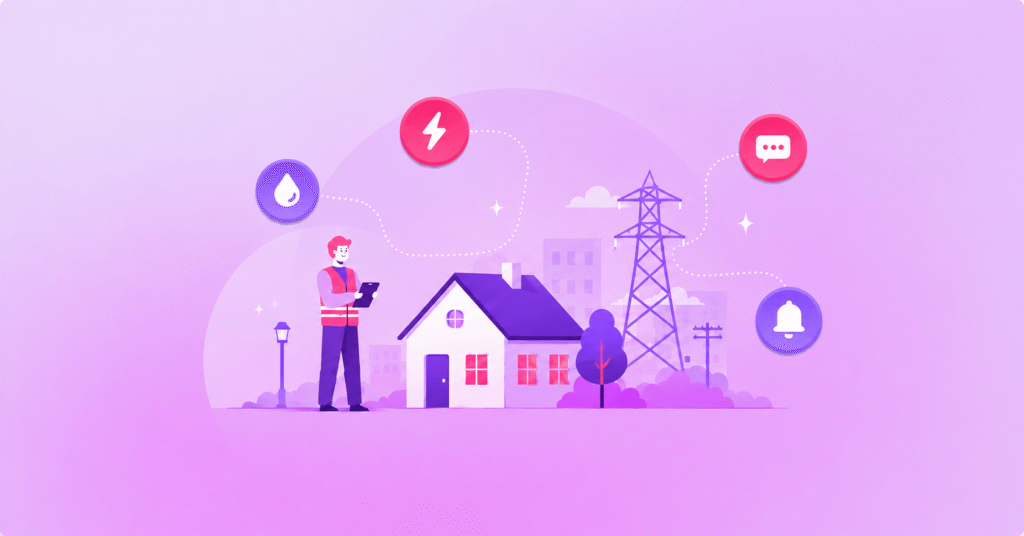
Utility communications refer to the messages sent by energy, water, gas and essential service providers to customers, staff and field teams.
These communications cover a wide range of scenarios, from outage alerts and billing reminders through to planned maintenance notices, technician visit updates and internal operational messaging.
For most utility providers, SMS is the starting point for these communications because of its reach and reliability. But increasingly, providers are looking at how to extend that across channels like RCS and WhatsApp to support richer, two-way interactions – more on this later!
The challenge facing many utility providers is that lots of these communications are still delivered via manual processes or disconnected systems, creating delays, inconsistencies and unnecessary pressure on operational teams.
These are just some of the reasons why getting utility communications right is so important. Let’s take a look at them in more detail.
Why Utility Customer Communication Matters
Utility providers sit in a unique position.
Because for many customers, switching utility provider isn’t as easy as going to a different supermarket for their weekly shop.
Whether it’s a long-term contract, limited options in their area, or essential services where there’s simply no alternative, the relationship between a utility provider and their customer tends to be a longer one than in most industries.
But that doesn’t mean communication can afford to be an afterthought.
Customers expect to be kept informed, particularly during outages, billing cycles or service disruptions. When they’re not, they pick up the phone.
During outages, customers who don’t receive updates call in for information that could have been sent to them. During billing cycles, customers who don’t receive clear reminders miss payments. During planned works, customers who aren’t notified in advance lose confidence in their provider.
Each of these scenarios creates operational cost. With the average utility customer service call costing $9.54, even a small spike in inbound enquiries during a disruption adds up quickly.
This highlights how getting utility communications right isn’t just about improving the customer experience, but also about driving efficiencies that can have a direct impact to an organisation’s bottom line.
Common Utility Communication Use Cases
Utility providers communicate with customers, staff and field teams across a wide range of scenarios.
Here are some of the most common use cases where messaging plays a critical role.
Outage Alerts and Restoration Updates
Outages are where utility communication is most visible and most critical.
Customers need to know what’s happened, which areas are affected and when service is expected to be restored. Automated alerts triggered directly from operational systems ensure those updates go out in real time, rather than relying on staff to manually draft and send messages while managing the disruption itself.
Two-way messaging adds another layer. Customers can reply to check status, report issues or confirm restoration, reducing the volume of inbound calls to the contact centre.
Billing and Payment Communications
Late payments are a persistent challenge for utility providers, and manual follow-up is one of the least efficient ways to manage them.
Automated billing reminders, payment links and overdue notices give customers a clear prompt to act. Two-way flows allow customers to request payment plans, extensions or flag disputes directly within the message, removing friction for both the customer and the billing team.
Planned Works and Maintenance Notifications
Planned works affect customers directly, and the communication around them needs to be clear and timely.
Advance notice of maintenance schedules, road closures or service interruptions helps customers prepare. Technician ETAs, appointment confirmations and rescheduling prompts reduce missed visits and keep field operations running smoothly.
Customer Support
Not every customer interaction needs to go through a contact centre.
Two-way messaging gives customers a simple way to ask questions, check account details or get help without calling in. For utility providers managing high volumes of routine enquiries, this reduces the load on support teams while giving customers a faster path to resolution.
Internal Staff Communication
Utility communication isn’t limited to customers.
Field teams, depot staff and operational crews need timely information to manage shifts, respond to incidents and coordinate across locations. SMS gives providers a reliable way to reach distributed teams quickly, particularly those who aren’t desk-based or don’t have regular access to email.
Benefits of Automating Utility Communications
When utility communications are automated and triggered directly from operational systems, the benefits are felt across both customer experience and day-to-day operations.
- Reduced Contact Centre Pressure: Proactive notifications during outages and billing cycles mean fewer customers calling in for information they should already have.
- Faster Customer Response Times: Updates triggered in real time reach customers faster than manual processes allow, keeping them informed when it matters most.
- Improved Customer Trust: Customers who are kept informed during outages and disruptions feel more confident in their provider, even when things go wrong.
- Lower Operational Costs: Less manual effort across billing, field ops and support teams means resources can be focused where they’re needed most.
- Better Visibility and Reporting: A clear record of what was sent, when and to whom helps providers identify patterns and improve communication over time.
Best Practices for Utility Customer Communication
Every utility provider communicates with customers differently, but the ones getting the best results tend to follow a similar set of principles.
Automate Where It Matters Most
Not every utility communication needs to be automated, but the ones that do tend to be the highest volume and most time-sensitive.
Outage alerts, billing reminders and technician visit confirmations are the clearest starting points. These are scenarios where manual processes create the most friction, and where automation delivers the most immediate return.
Utilise Two-Way Messaging
One-way alerts have their place, but they don’t give customers a way to take action.
Two-way messaging allows customers to confirm appointments, request payment plans, check outage status or flag issues directly within the message. This reduces the number of interactions that need to be handled by a person and gives customers a faster way to resolve common requests.
Send Updates Before Customers Ask
The most effective utility communication is proactive, not reactive.
When customers receive an outage alert before they lose power, a billing reminder before a payment is overdue, or a technician ETA before they start wondering where the engineer is, the experience feels managed rather than chaotic.
Every update that reaches a customer before they need to call in is one fewer enquiry for the contact centre to handle.
Use Multiple Messaging Channels
SMS is the most accessible channel for utility communications, but different messages suit different channels.
RCS allows providers to send branded, interactive messages with buttons, rich media and verified sender profiles, which is particularly useful during outages or billing scenarios where trust matters. WhatsApp is valuable in markets where customers are already active on the platform.
The most effective approach is to use multiple channels together through an omnichannel messaging platform, with SMS as the reliable fallback when other channels aren’t available.
Utility Communication FAQs
What are utility communications?
Utility communications are the messages sent by energy, water, gas and essential service providers to customers, staff and field teams. They cover everything from outage alerts and billing reminders through to planned works notifications, technician visit updates and internal operational messaging. These communications can be delivered across SMS, RCS, WhatsApp, email and voice.
Can utility providers use SMS, RCS and WhatsApp together?
Yes. SMS provides the broadest reach, RCS enables richer branded messaging with interactive buttons and verified sender profiles, and WhatsApp supports two-way conversations in markets where customers are already active on the platform. An omnichannel messaging platform allows utility providers to manage all three from a single environment.
What is the difference between one-way and two-way utility messaging?
One-way messaging sends information to customers without giving them a way to respond. Two-way messaging allows customers to reply directly within the message thread to confirm appointments, check outage status, request payment support or flag issues. Two-way messaging reduces the need for customers to call in and helps utility providers handle common requests more efficiently.
What is the best way to notify customers during an outage?
Automated SMS alerts triggered directly from operational systems are one of the most effective ways to notify customers during an outage. Messages can include what’s happened, which areas are affected, estimated restoration times and a link for live updates. Two-way messaging also allows customers to reply for status checks, reducing inbound call volumes.
Is SMS secure enough for utility customer communications?
Enterprise messaging platforms like Soprano are SOC 2 and ISO 27001 certified, with encryption, role-based access controls, audit trails and data governance built in. This ensures utility customer communications meet the security and governance standards providers operate under.
Improve Your Utility Communications with Soprano
Soprano has spent over 30 years helping some of the world’s largest utility and essential service providers get critical customer communications right.
When an outage needs to be communicated, a billing reminder needs to land, or a technician visit needs to be confirmed, there’s no room for that message to fail.
That’s why leading utility providers trust Soprano’s utility messaging platform to power their customer communications at scale, across SMS, RCS, WhatsApp and voice.
If you’d like to see how automated utility communications could work across your operations, get in touch for a personalised platform demo.