SMS vs MMS Differences
An appointment reminder and an image-led promotion can both reach a customer’s phone, but they do not need the same type of message.
For marketing and customer experience teams, SMS vs MMS is a practical choice between simplicity, media support, cost and reach.
SMS suits short alerts and updates, while MMS can include images or other media where your audience and provider support it.
If you’re deciding which format to use, start with what your customers need to know, then consider whether rich media adds real value.
What Is the Difference Between SMS and MMS?
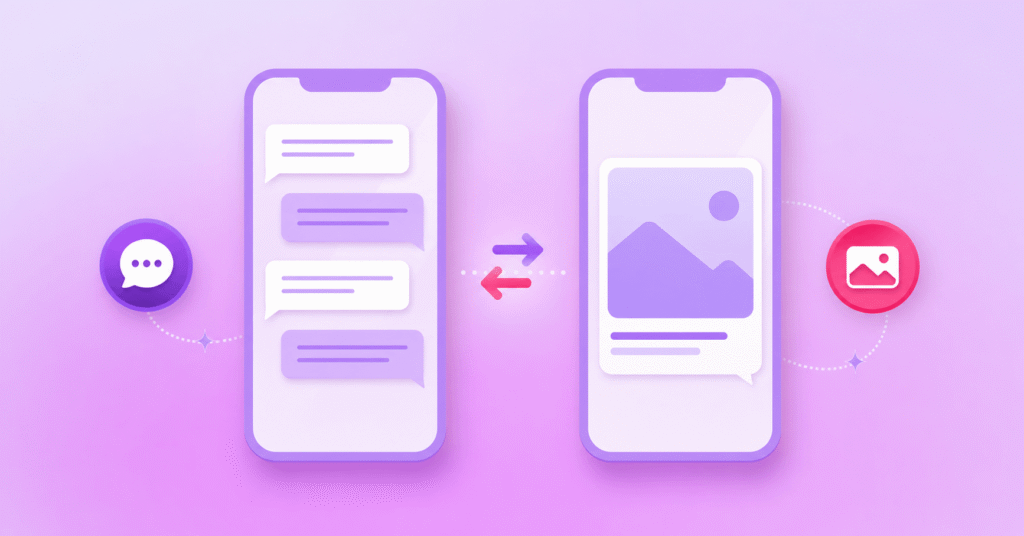
The difference between SMS and MMS is that SMS sends text-only mobile messages, while MMS can include images, audio or video alongside text. A standard SMS typically supports up to 160 GSM-7 characters in a single segment, with longer messages potentially divided into multiple segments. MMS usually costs more, and support varies by market, carrier and provider. For businesses, the right choice depends on message content, audience, urgency and channel availability.
What Are SMS and MMS?
Short Message Service (SMS) delivers text messages to mobile numbers without requiring recipients to install a separate messaging app.
For businesses, it is a practical choice for alerts, reminders and other time-sensitive information.
For higher-volume communication, Soprano’s business SMS platform supports campaign management and automated messaging.
Multimedia Messaging Service (MMS) supports media alongside text, where the network, device and provider allow it.
That can be useful when a picture explains something faster than words, but MMS availability and rendering need checking across your audience.
SMS vs MMS: Key Differences at a Glance
Use this comparison to narrow down your channel choice before checking the specifics of your destinations and messaging provider.
| Comparison | SMS | MMS |
|---|---|---|
| Format | Text-only mobile messaging | Text with supported multimedia |
| Message length | Typically 160 GSM-7 characters in one segment; longer texts may be segmented | Text and overall payload limits vary by implementation |
| Media | No native image, audio or video attachments | Can carry images, audio or video where supported |
| Reach | Broad compatibility across mobile devices | Coverage and handset support vary more by market |
| Cost | Often priced by SMS segment and destination | Usually a higher charge per MMS; terms vary |
| Sender identity | Number or supported sender ID, subject to local rules | Available sender options and rules vary by market |
| Analytics | Delivery reporting depends on provider; no native read receipt | Delivery reporting depends on provider; no guaranteed read receipt |
| Typical use | OTPs, urgent alerts, reminders, short updates | Image-led promotions, visual confirmations, media-rich notices |
Message Length, Encoding and Segmentation
A standard single-part SMS commonly supports up to 160 characters when the text uses the GSM-7 character set.
The underlying GSM alphabet standard explains this encoding.
If you write a longer message, it may be split into connected segments, commonly allowing 153 GSM-7 characters per segment.
Emoji and many non-GSM characters can require Unicode encoding, reducing the single-segment allowance to around 70 characters; some GSM-7 extension characters also count as two character units.
For your budget, this distinction matters: a message that looks like one continuous text on the recipient’s phone may be billed as multiple SMS segments.
Check your provider’s encoding and segment estimates before launching a large campaign.
Media Support, Compatibility and Customer Experience
SMS can include a link to a hosted image or webpage, but the message itself remains text-only.
MMS can display supported media within the messaging experience, which may suit visual content such as promotional images or product photographs.
Media file size, compression and rendering differ across carriers and devices.
If your customers span several countries, test MMS availability and how the same asset appears on representative handsets before relying on it.
How Pricing and Delivery Differ
SMS and MMS are not priced using one universal model.
Costs can differ by destination, volume, sender type, carrier and provider, with long SMS potentially charged as several segments.
MMS is commonly more expensive per message and may have additional media restrictions.
A reported network delivery event should not be treated as proof that the recipient opened or read the content.
Sender identity is another consideration.
In Australia, the ACMA SMS Sender ID Register rules apply to SMS and MMS messages that use alphanumeric sender IDs.
Local requirements and restrictions may also affect your campaigns in other markets.
When Should a Business Use SMS?
Choose SMS when your priority is getting concise information to a broad audience without asking recipients to use a particular app or rich messaging capability.
- Appointment reminders: Scheduling updates with a clear date, time or action.
- Authentication and alerts: One-time passcodes, service alerts and operational notices where speed and simplicity matter.
- Short campaigns: Short offers and updates sent through A2P SMS messaging when text is the right fit.
When Should a Business Use MMS?
Consider MMS when an image or other supported media adds practical value to your message, rather than simply making it more colourful.
Examples include showing a product alongside an offer, sending a visual event invitation or sharing a photo that helps a customer identify an item.
Before choosing MMS, confirm that the format is supported across your audience, test the asset and compare its cost with an SMS linking to the same content.
Where Do RCS and Other Rich Channels Fit?
SMS and MMS are only part of the channel decision.
If you need interactive buttons, richer branded messaging or guided customer journeys, RCS Business Messaging may be more suitable where compatible devices and network support are available.
The GSMA RCS Universal Profile describes the evolving RCS experience, including richer interactions.
WhatsApp can also support multimedia and conversational journeys for customers using that channel, subject to its platform rules and your audience’s preferences.
An omnichannel messaging approach helps you plan for different customer needs rather than choosing one format for every message.
SMS can remain the dependable option for simple notifications and appropriate fallback journeys.
SMS vs MMS FAQs
Can You Send Pictures Through SMS?
You cannot send pictures through SMS as native attachments because SMS is a text-only format. You can include a link to an image or use MMS or another supported rich messaging channel to display media within the message.
Does an SMS Longer Than 160 Characters Cost More?
An SMS longer than 160 characters can cost more because it may be divided into multiple billable segments. The actual limit and cost depend on the message encoding, length and provider pricing model.
Is MMS Available in Every Country?
MMS is not available in every country through every carrier or messaging provider. Confirm coverage, supported media formats and size limits before planning a campaign that relies on MMS delivery.
Is MMS More Expensive Than SMS?
MMS is generally more expensive than SMS because it supports multimedia content and typically uses a different pricing structure. However, the actual cost depends on your messaging provider, destination country, message volume and available carrier support.
Should My Business Use SMS or MMS?
Your business should use SMS when you need to deliver straightforward, time-sensitive messages to a broad audience, such as appointment reminders, authentication codes or service alerts. MMS may be more suitable when images or other media are essential to the message, provided your audience and messaging provider support it.
Choose the Right Mobile Messaging Channel With Soprano
Your messaging strategy should start with the information customers need, not with the most visually elaborate channel.
For some journeys, a short SMS is the clearest option; for others, richer content can help explain the next step.
Soprano’s SMS messaging platform supports business communications at scale, while its RCS and omnichannel capabilities provide additional options when the use case calls for them.
If you are comparing channels for campaigns, alerts or customer journeys, speak to a Soprano expert about the requirements, destinations and message formats that make sense for your organisation.