Customer Segmentation for Messaging
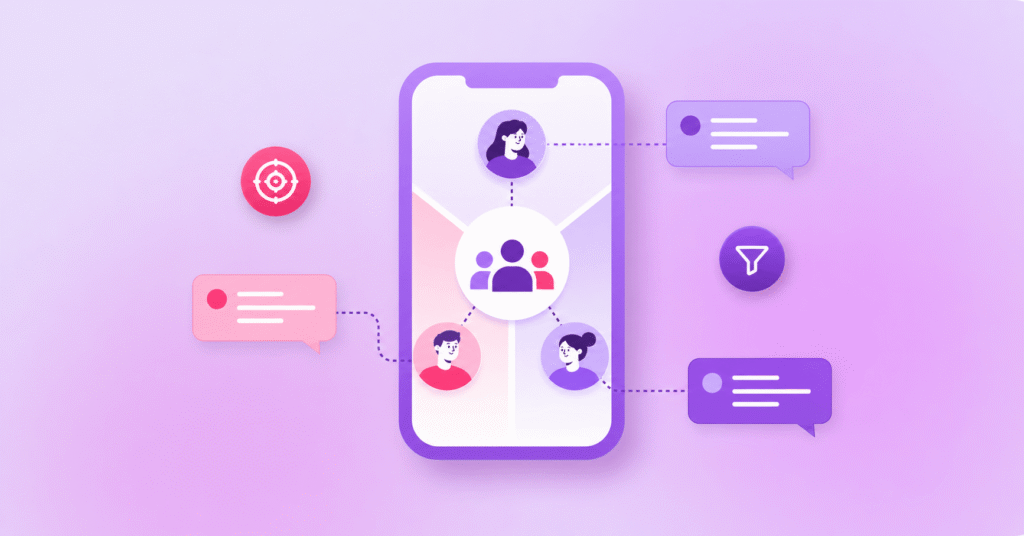
The more customer data your business collects, the more tempting it becomes to build different audience segments before anyone has decided what they are for.
Good customer segmentation for messaging works the other way around.
Start with the communication you need to improve, then use the minimum useful data to decide who should receive it.
This guide looks at practical segmentation models, how they work across messaging channels and how to keep personalisation, consent and data quality under control as your strategy becomes more sophisticated.
How Should You Segment Customers for Messaging?
Customer segmentation for messaging starts by grouping recipients according to characteristics that genuinely change what you should communicate, when you should send it or which channel you should use.
Useful segments can be based on lifecycle stage, behaviour, location, preferences, value or service needs, with consent and channel preferences kept attached to each customer profile.
Start with a clear communication goal, use only data that improves the message and test whether the segment produces a better customer outcome.
What Is Customer Segmentation for Messaging?
Customer segmentation is the practice of dividing a wider audience into smaller groups that share relevant characteristics or behaviours.
In messaging, the point is not simply to create more groups, but to make a communication more useful for the people receiving it.
For example, a customer waiting for an order needs different information from someone browsing a product range, even if both people are part of the same overall customer database.
An omnichannel messaging platform can then help you apply those audience rules across channels, while the underlying segment logic should still come from a clear customer or operational need.
Segmentation is also different from personalisation: a segment decides which group a person belongs to, while personalisation changes the content using information about that individual.
Why Does Segmentation Improve Business Messaging?
Segmentation helps you reduce the number of messages that are technically deliverable but irrelevant to the person receiving them.
That can make it easier to vary timing, content, channel and next steps according to where someone is in a journey rather than treating every contact as if they have the same need.
It also gives your team a clearer way to test messaging because you can compare whether a defined group responded differently after a change in content or channel.
The important part is restraint, because a segment that does not change the decision you make about the message is usually adding complexity rather than value.
Which Customer Segmentation Models Are Most Useful?
You do not need a complicated segmentation model to get started, and five practical types cover many business messaging journeys.
Lifecycle Segmentation
Lifecycle segmentation groups customers according to where they are in a relationship or journey, such as onboarding, active service, renewal, lapsed use or post-purchase support.
That can help you avoid sending acquisition-style messages to customers who are already using the service and instead focus on the next useful step for them.
Behavioural Segmentation
Behavioural segmentation uses actions such as purchases, bookings, service usage, browsing events or previous message interactions to identify what a customer may need next.
Google Analytics, for example, describes an audience as a group of users who share attributes or behavioural data, which is a useful way to think about event-based audience building before those audiences are activated in another system.
Preference Segmentation
Preference segmentation focuses on the choices a customer has made, including topics of interest, preferred channel, language, communication frequency or types of notification.
These preferences should be treated as operational rules, not optional decoration, because they can determine whether your message belongs in SMS, email, WhatsApp or another supported channel.
Value Segmentation
Value segmentation can group customers according to factors such as spend, account tier, service level or commercial relationship when those differences genuinely affect the service or communication they should receive.
Be careful not to turn this into a blanket rule that higher-value customers always deserve more communication, because frequency should still be driven by relevance and permission.
Service-Need Segmentation
Service-need segmentation groups people around a current operational requirement, such as an outage area, delayed delivery, upcoming appointment or unresolved support case.
This is often one of the most immediately useful forms of segmentation because the message can be tied directly to something the recipient is experiencing right now.
How to Build a Practical Messaging Segmentation Strategy
1. Start with the Message Decision
Write down what you would change if you knew more about the customer, such as the content, timing, channel, frequency or call to action.
If the answer is “nothing”, you probably do not need a new segment.
2. Identify the Minimum Useful Data
Choose the smallest set of reliable fields or events needed to make that decision, and check who owns the data and how often it is updated.
A simple recent-purchase flag that is current can be more useful than a sophisticated scoring model built on incomplete records.
3. Keep Consent and Suppression Rules Attached
Your segment should never override opt-outs, legal restrictions, channel preferences or internal suppression rules just because the customer meets the targeting criteria.
Treat eligibility and permission as part of the audience definition itself.
4. Test a Meaningful Difference
Change something that should matter to the recipient, then compare the result with a sensible baseline rather than measuring whether the segment merely exists.
That might mean testing a service reminder sent at a different stage, a more relevant next step or a different channel for customers who have expressed a preference.
5. Retire Segments That No Longer Help
Audience structures accumulate quickly, so give each segment an owner and review whether it is still current, distinct and useful.
If two segments now receive the same communication, you may be able to simplify the model without losing anything for the customer.
How Segmentation Works Across SMS, Email, WhatsApp and RCS
The segment can stay consistent even when the channel changes, but the message should still be designed for the strengths and constraints of that channel.
A short service update might fit business SMS, while a richer guided interaction could be better suited to the WhatsApp Business API or RCS where audience availability and the journey support it.
Email may be more appropriate when the recipient needs detail, structured content or documents, while SMS can remain useful for time-sensitive communication and fallback.
For a retail example, our guide to SMS for retail customer journeys shows how messaging can support different points in the customer experience rather than treating every message as a promotion.
The channel decision should follow the customer need, urgency, consent, content and availability, not simply the segment label.
Personalisation, Consent and Privacy Considerations
Segmentation becomes a privacy and governance question as soon as you use personal data to infer, evaluate or predict things about individual customers.
The ICO’s current profiling guidance explains that profiling can involve using personal data to evaluate factors such as preferences, behaviour, location or economic situation, and it notes that its guidance is currently under review following changes to UK law.
That does not mean normal audience segmentation is automatically prohibited, but it does mean your team should understand the lawful basis, transparency, data minimisation and individual rights that apply in the markets where you operate.
The NIST Privacy Framework is another useful risk-management lens for thinking about how personal data is used across processes without treating privacy as a campaign-only responsibility.
Avoid using sensitive characteristics simply because the data exists, and involve privacy or legal teams when a segment could create a material effect for the person or rely on protected or highly sensitive information.
How to Measure and Improve Segment Performance
Measure whether the segment changed the customer or operational outcome you were trying to improve.
Useful measures can include task completion, response, conversion, repeat contact, opt-out behaviour, channel switching or the number of people who needed a different route after receiving the message.
Look for unintended effects as well, because a segment can improve one metric while increasing frequency, complaints or confusion elsewhere in the journey.
Over time, merge segments that behave the same, refine the ones that show a meaningful difference and remove rules that are no longer supported by good data.
Common Customer Segmentation Mistakes
Most segmentation problems come from making the audience model more complicated than the communication problem requires.
- Starting with the data: build segments around a message decision, not around every field available in your CRM.
- Confusing segmentation with personalisation: first decide who should receive the message, then decide which individual details improve it.
- Ignoring permissions: keep consent, channel preferences and suppression rules attached to every audience.
- Creating overlapping segments without ownership: make it clear which rule wins when a customer qualifies for several journeys at once.
- Never retiring old audiences: review whether each segment still changes the message or outcome enough to justify its complexity.
Customer Segmentation for Messaging FAQs
What Is the Difference Between Customer Segmentation and Personalisation?
Customer segmentation groups people by shared characteristics, behaviours or needs, while personalisation adapts the message using information about the individual recipient.
How Many Customer Segments Should a Business Have?
There is no ideal number of customer segments, so keep only the groups that meaningfully change the message, timing, channel or next action and that your team can manage reliably.
What Data Can You Use for Customer Segmentation?
Useful segmentation data can include lifecycle stage, behaviour, preferences, location, product relationship, engagement or value, provided the data is accurate and used in line with your privacy, consent and governance requirements.
Can Customer Segmentation Work Across Multiple Messaging Channels?
Yes, the same customer segment can inform SMS, email, WhatsApp or RCS journeys, but the final channel should still reflect consent, customer preference, urgency, content and availability.
Build More Relevant Messaging Journeys with Soprano
A practical segmentation strategy should make communication easier to understand and manage, not create a maze of audiences that only your marketing system can explain.
Soprano Connect supports coordinated communication across channels including SMS, RCS, WhatsApp, Viber, email, automated voice and Conversational AI, allowing organisations to apply channels according to audience, urgency, content, availability and business rules where supported.
If you are reviewing how segmentation should work across your messaging journeys, speak to a Soprano expert about the channels, data and workflow rules you need to bring together.